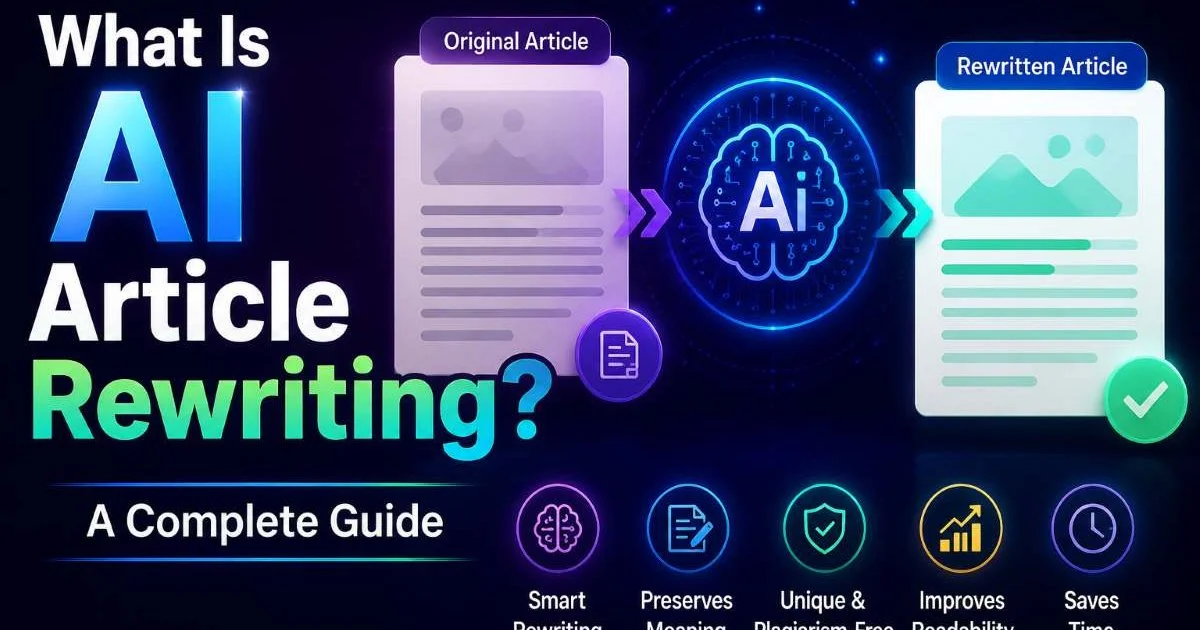
AI rewriting for Medium is the process of using artificial intelligence tools to transform rough drafts, scattered notes, and reference URLs into polished, publication-ready articles optimized for the Medium platform. If you've ever stared at a messy Google Doc full of half-formed ideas and wondered how to turn it into something readers actually want to finish, this concept is built for you.
The gap between a raw idea and a published Medium article involves writing, rewriting, SEO structuring, tone consistency, and formatting. That's a lot of work for one person. AI content rewriting tools now handle much of that heavy lifting, letting writers focus on ideas rather than mechanics. For aspiring Medium writers, understanding this workflow can dramatically reduce the time between "I have a thought" and "I hit publish." This article breaks down exactly what this process involves, how it works, and why it matters for anyone serious about growing on Medium.
Key Takeaways
- AI rewriting for Medium turns messy drafts into structured, reader-friendly articles faster than manual editing.
- Style personas let you maintain a consistent voice across every piece you publish.
- SEO optimization tools help your Medium articles rank in Google, not just Medium's internal feed.
- Validation checks catch structural and readability problems before you hit the publish button.
- Combining AI assistance with your own expertise produces better results than either alone.
How AI Rewriting for Medium Works
From Raw Input to Structured Draft
The process starts with whatever you have: bullet points from a brainstorming session, a voice memo transcript, a collection of URLs you've bookmarked, or a rough draft that reads more like a journal entry than an article. AI rewriting tools ingest this raw material and restructure it into coherent sections with proper headings, logical flow, and reader-friendly paragraph lengths. Think of it as having an editor who works in seconds rather than days. The output isn't a finished masterpiece, but it's a solid foundation that needs your expertise layered on top.
Most tools in this space use large language models to handle the transformation. The quality of output depends heavily on the quality of your prompts and inputs. Writing better prompts is a skill worth developing, and resources like this guide on AI prompt writing tips can help you get significantly better results from any AI tool. The more specific your instructions, the closer the first draft lands to your vision.
Always include your target audience, desired tone, and key points when feeding raw notes into an AI rewriting tool.
The structural transformation is where AI shines most. It can take 15 disconnected bullet points and organize them into a logical narrative arc with an introduction, supporting sections, and a conclusion. It handles transitions between ideas, suggests subheadings, and formats content for Medium's specific rendering engine. This isn't magic; it's pattern recognition applied to millions of well-structured articles the model trained on.
SEO and Validation Layers
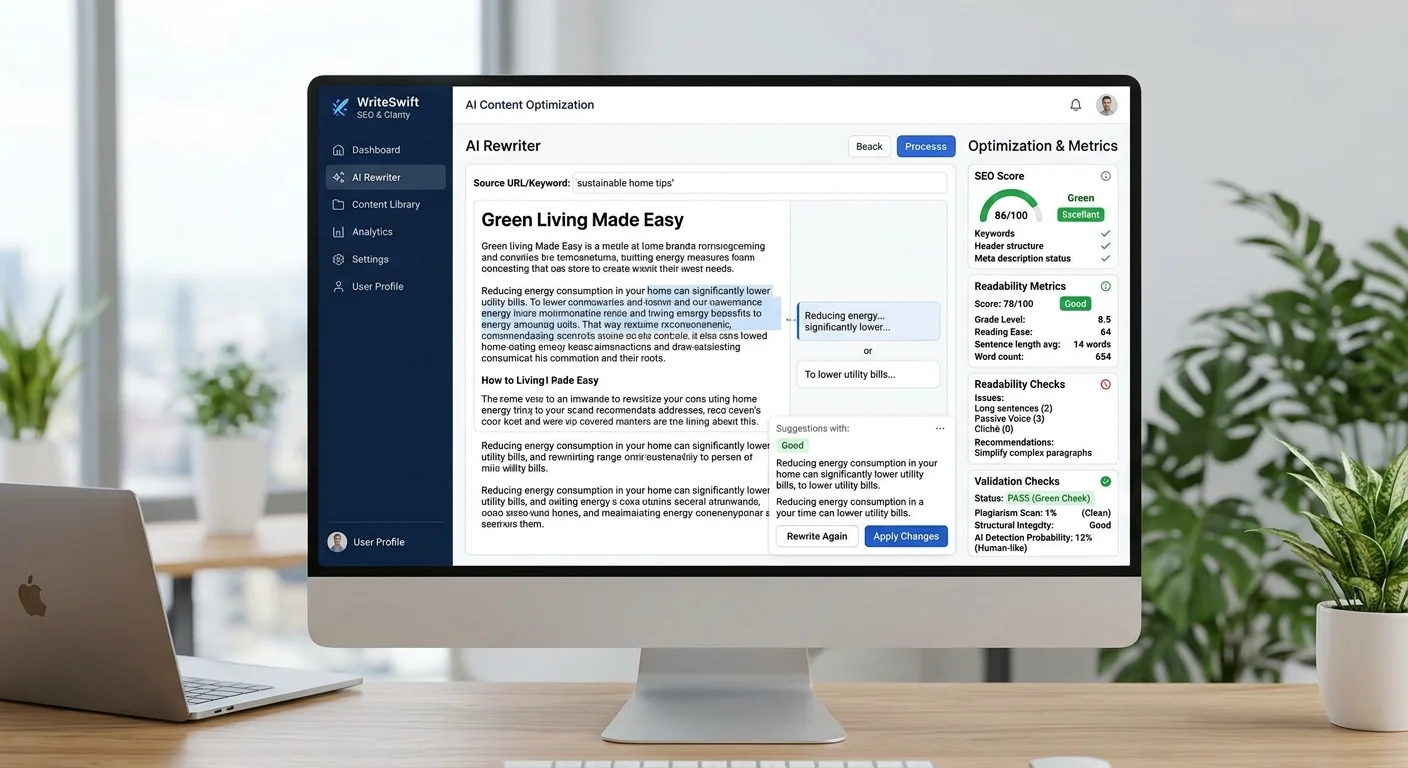
Beyond basic rewriting, serious tools add medium article SEO optimization as a built-in step. This means analyzing your draft for keyword placement, meta description quality, heading hierarchy, and readability scores before you ever paste it into Medium's editor. An SEO optimization tool integrated into the rewriting workflow catches problems that would otherwise cost you search traffic for months. Google indexes Medium articles aggressively, so ranking well there can drive sustained organic readership.
Validation goes beyond SEO. It includes checking for overly long paragraphs, missing alt text suggestions for images, broken logical flow, and even tone consistency. Some platforms, like Optimize Content, combine rewriting with validation and publishing guidance into a single workflow. This end-to-end approach means you don't need five different browser tabs open to go from draft to published piece.
Why It Matters for Aspiring Medium Writers
Medium rewards consistency. The algorithm favors writers who publish regularly, engage readers with well-structured content, and keep people on the platform. But most aspiring writers aren't full-time content creators. They have jobs, responsibilities, and limited hours to dedicate to writing. AI rewriting for Medium compresses the production timeline so that a writer with three hours a week can publish as frequently as someone dedicating ten hours. That's not a small advantage when you're trying to build an audience from zero.
Understanding why we write and what makes writing effective remains fundamentally human. AI handles the mechanical parts: restructuring, optimizing, formatting. You handle the parts that actually matter to readers: original thinking, personal experience, and genuine perspective. The combination is powerful. Writers who use AI rewriting for Medium as an accelerator (not a replacement) consistently outperform those who either write everything manually or delegate everything to AI.
Publishing Consistency and Speed
Consider the typical aspiring Medium writer's workflow without AI assistance. They write a draft, let it sit for a day, revise it, check formatting, manually research SEO considerations, second-guess their headline, and finally publish. That's three to five days per article. With an AI-assisted workflow, the same writer feeds their notes into a rewriting tool, reviews and personalizes the output, runs validation, and publishes. The whole process can take two to three hours. Publishing to Medium becomes a weekly habit instead of a biweekly struggle.
"Writers who use AI as an accelerator, not a replacement, consistently outperform those at either extreme."
Speed also means you can experiment more. Try different topics, test various headlines, and explore new formats without the sunk cost of spending an entire weekend on a single post. If an article doesn't perform, you haven't lost days of work. This freedom to experiment is how new writers find their niche and audience on Medium faster than the traditional approach allows.
Common Misconceptions About AI Rewriting
The Plagiarism and Quality Question
The most common misconception is that AI rewriting means copying someone else's work with different words. That's spinning, not rewriting. Modern AI content rewriting takes your original ideas, your notes, your unique angle, and restructures them into polished prose. The input is yours. The output is a better-organized version of your thinking. No ethical writer uses AI to plagiarize, and the tools themselves are designed to generate original language from the concepts you provide.
Another persistent myth: AI-generated content always sounds robotic and generic. This was true in 2021. It's much less true now, especially when you use style personas for writing. A style persona is a set of instructions that tells the AI how to sound: conversational, academic, witty, authoritative, or any combination. Choosing the right language model for text generation also matters significantly, as different models excel at different tones and formats.
AI-rewritten content still needs a human review pass. Models occasionally hallucinate facts or miss nuance that only you would catch.
Some writers worry that using AI tools violates Medium's terms of service. Medium's current policy requires disclosure of AI assistance in certain cases, but it does not ban AI-assisted writing. The platform distinguishes between content that is entirely AI-generated with no human involvement and content where AI served as a writing aid. Most AI rewriting for Medium falls firmly in the second category, especially when you're starting with your own ideas and adding your own edits to the output.
Finally, there's the belief that AI tools make writing skill irrelevant. The opposite is true. Writers with strong fundamentals get dramatically better results from AI tools because they write better prompts, recognize weak output immediately, and know exactly where to add the human touch that makes an article memorable. AI amplifies skill; it doesn't replace it.
| Myth | Reality | Impact on Writers |
|---|---|---|
| AI rewriting is plagiarism | It restructures your original ideas | Your unique perspective stays intact |
| Output always sounds robotic | Style personas create natural tone | Readers can't distinguish well-edited AI drafts |
| Medium bans AI content | Medium allows AI-assisted writing | Disclose appropriately and publish confidently |
| Writing skill becomes irrelevant | Skilled writers get better AI output | Fundamentals matter more, not less |
| AI handles everything automatically | Human review is always necessary | Plan for editing time in your workflow |
How It Relates to Similar Tools and Concepts
Style Personas and Brand Voice
AI rewriting for Medium sits at the intersection of several related concepts. Grammar checkers like Grammarly fix surface-level errors but don't restructure content or optimize for SEO. Paraphrasing tools swap words but don't understand article architecture. Full AI writing generators (like asking ChatGPT to "write an article about X") create content from scratch but lack your personal knowledge and voice. AI rewriting occupies a middle ground: it takes your raw material and elevates it while preserving what makes it yours.
Style personas for writing deserve special attention because they solve one of the biggest problems new Medium writers face: inconsistency. When you define a persona (your preferred sentence length, vocabulary level, use of humor, paragraph structure) and apply it across every article, readers begin to recognize and trust your voice. This is how publications build brand identity, and individual writers can do the same thing by saving persona configurations in their rewriting tools.
The SEO component also connects to broader content marketing practices. Medium article SEO borrows from the same principles that govern blog optimization anywhere: keyword research, heading structure, internal linking, and readability. What makes Medium unique is that articles benefit from both the platform's domain authority and your individual efforts. An article that's well-optimized for search can continue generating reads for years after publication, long after it's fallen off Medium's recommendation feed.
Save your style persona settings and SEO preferences as a template so every new article starts from the same quality baseline.
Content validation, the final piece, connects to the quality assurance processes used by professional editorial teams. Newsrooms have editors, fact-checkers, and copy editors who review work before publication. Solo Medium writers typically skip all of these steps because they don't have a team. AI validation acts as a compressed editorial review, flagging issues that a human editor would catch. It's not perfect, but it's infinitely better than publishing with no review at all, which is what most aspiring writers currently do.
Frequently Asked Questions
?How do I set up a style persona for consistent Medium voice?
?Does AI rewriting replace manual editing before publishing on Medium?
?How long does the raw-draft-to-Medium-ready workflow actually take?
?Can AI rewriting tools accidentally produce plagiarized Medium articles?
Final Thoughts
AI rewriting for Medium isn't about replacing your voice or automating creativity. It's about removing the friction between having something worth saying and actually saying it well on a platform where presentation matters.
The writers who thrive on Medium in the coming years will be those who pair genuine expertise with smart tools. Start with your own ideas, let AI handle the structural and optimization work, review everything with a critical eye, and publish with confidence.
Disclaimer: Portions of this content may have been generated using AI tools to enhance clarity and brevity. While reviewed by a human, independent verification is encouraged.