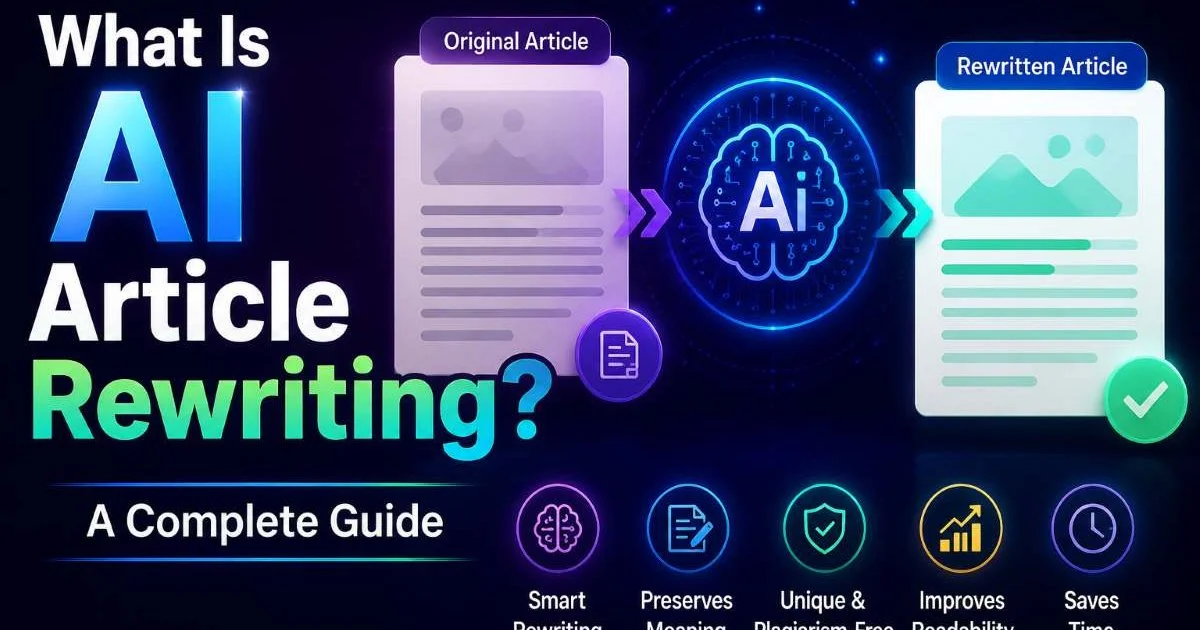
Content rewriting tools have become essential companions for Medium writers who want to transform rough drafts into polished, publication-ready articles. Whether you're repurposing existing content, improving readability, or optimizing for discoverability, these AI-powered tools can dramatically reduce your editing time. But here's the thing: most writers use them wrong.
They paste in text, hit a button, and publish whatever comes out. That approach produces generic, soulless content that readers scroll past. The real skill lies in understanding how to guide these tools strategically, preserving your voice while improving structure, clarity, and engagement.
This guide walks you through a practical, step-by-step process for using content rewriting tools effectively as a Medium writer, from selecting the right tool to publishing with confidence.
Key Takeaways
- Choose content rewriting tools that allow tone and style customization for Medium's audience.
- Always start with a structured draft before feeding anything into an AI rewriter.
- Use rewriting tools for refinement, not as a replacement for original thinking.
- Validate every AI output for accuracy, voice consistency, and Medium formatting standards.
- Combine multiple tools in a workflow rather than relying on a single solution.

Step 1: Choose the Right Rewriting Tool for Medium Writing
What to Look For in a Rewriting Tool
Not all content rewriting tools are built for the same purpose. Some focus on academic paraphrasing, others on SEO optimization, and a few target long-form editorial content. For Medium writers, you need a tool that understands conversational yet authoritative tone, supports long-form content without truncating ideas, and offers granular control over output style. If your tool can only spin sentences with synonym replacements, it's the wrong fit entirely.
The best tools for Medium writing let you specify a target audience, adjust formality levels, and preserve your narrative structure. Look for options that handle section-level rewrites rather than forcing you to process an entire article at once. This granularity matters because your introduction might need a different treatment than your technical breakdown. A comprehensive overview of AI article rewriting approaches can help you understand the broader landscape before committing to a specific tool.
You should also consider whether the tool integrates with your existing workflow. Can you export cleanly to Medium's editor? Does it maintain heading hierarchy and formatting? These practical details save you hours of reformatting. Tools that output raw markdown or clean HTML tend to work best with Medium's import capabilities.
Comparing Popular Options
The market for AI writing tools has exploded, but their capabilities for long-form rewriting vary significantly. Some writers prefer general-purpose LLMs like Claude or GPT-4, while others use dedicated rewriting platforms. The underlying language model matters considerably; a detailed comparison of the best LLMs for technical writing can help you evaluate which engines produce the most coherent long-form output for your specific niche.
Step 2: Prepare Your Draft Before Rewriting
Structure First, Polish Second
The biggest mistake aspiring Medium writers make is feeding unstructured notes into a rewriting tool and expecting a finished article. AI rewriters work best when they have a clear framework to improve upon. Before you open any tool, outline your article with defined sections, a clear thesis, and supporting points under each heading. This skeleton gives the AI guardrails to work within.
Your draft doesn't need to be beautiful. It needs to be complete and organized. Write out your ideas in plain language, even if the sentences are clunky or repetitive. Include the specific examples, data points, and anecdotes you want in the final piece. The rewriting tool will handle fluency and readability; your job is to supply the substance and structure that no AI can reliably generate from nothing.
Write your draft in bullet points first, then expand each bullet into a rough paragraph before rewriting.
Set Clear Rewriting Goals
Before hitting "rewrite," define what you actually want the tool to improve. Are you trying to make dense technical content more accessible? Tighten a rambling 3,000-word draft into 1,500 focused words? Shift the tone from academic to conversational? Each of these goals requires a different approach and often different tool settings. Writing down your specific objectives prevents the common trap of aimless revision cycles.
Consider creating a brief style guide for each article. Note your target word count, desired reading level, tone keywords (e.g., "conversational but authoritative"), and any phrases or structural elements you want preserved. Many content rewriting tools accept system-level instructions or style parameters. Feeding them explicit guidance produces dramatically better results than a generic "rewrite this" command.
Step 3: Run the Rewrite Strategically
The Section-by-Section Approach
Resist the temptation to paste your entire article into a rewriting tool at once. Processing a full article in one pass often produces inconsistent tone, loses transitional logic between sections, and sometimes drops key points entirely. Instead, rewrite section by section. Feed in your introduction separately, then each body section, and finally your conclusion. This approach gives you tighter control over each segment's quality.
When rewriting each section, provide the tool with context about the surrounding content. A simple instruction like "this section follows an introduction about X and precedes a section on Y" helps the AI maintain logical flow. Without this context, you'll end up with sections that read well individually but feel disjointed when assembled. Think of it as directing a conversation rather than issuing a single command.
"The best AI-rewritten content is invisible; readers should never suspect a tool was involved."
Track your revisions systematically. Keep your original draft, the first AI output, and your final edited version in separate documents or clearly labeled sections. This three-version approach lets you catch cases where the AI removed important nuance or introduced inaccuracies. It also helps you learn which prompting strategies produce the best results over time, building a personal playbook for future articles.
Prompting for Better Results
The quality of your rewrite depends almost entirely on how you prompt the tool. Vague instructions like "make this better" produce vague results. Specific instructions like "rewrite this paragraph to be more conversational, use shorter sentences, and add a concrete example after the second point" produce targeted improvements. Treat your prompts as editorial feedback you'd give to a human writer.
| Ineffective Prompt | Effective Prompt | Why It Works Better |
|---|---|---|
| "Rewrite this" | "Rewrite for a non-technical Medium audience, reading level grade 8" | Specifies audience and measurable readability target |
| "Make it better" | "Tighten this paragraph to 80 words while keeping the data point" | Defines clear constraint and preservation rule |
| "Change the tone" | "Shift from academic to conversational; use 'you' and active voice" | Names specific stylistic changes to implement |
| "Fix the intro" | "Rewrite the hook to open with a surprising statistic, then state the problem" | Prescribes structure and technique |
| "Make it longer" | "Expand with a real-world example of a freelancer using this approach" | Adds substance rather than padding |
AI tools sometimes "hallucinate" statistics or fabricate examples. Always verify any factual claims in rewritten output against original sources.
Step 4: Validate, Refine, and Publish on Medium
Quality Checks Before Publishing
After your rewrite is complete, run it through a systematic quality check. First, read the entire article aloud. This simple technique catches awkward phrasing, unnatural rhythm, and sentences that are technically correct but sound robotic. AI-generated prose often has a subtle uniformity in sentence length and structure that reading aloud immediately reveals. Mark any spots that feel mechanical and manually revise them.
Next, verify every factual claim, statistic, and example in the rewritten version against your original sources. Content rewriting tools occasionally introduce subtle inaccuracies, especially when paraphrasing data or technical concepts. A number might shift, a cause-and-effect relationship might reverse, or a nuanced point might get flattened into an oversimplification. This verification step is non-negotiable if you care about your credibility on Medium.
Publishing AI-rewritten content without verification can damage your reputation and violate Medium's quality guidelines.
Finally, run an originality check. While quality rewriting tools produce unique output, certain phrases or sentence patterns can closely mirror existing published content. Use a plagiarism detection tool to confirm your article is sufficiently original. Medium's algorithm and readers both penalize content that feels derivative or recycled, so this step protects both your distribution potential and your reader relationships.
Medium-Specific Formatting
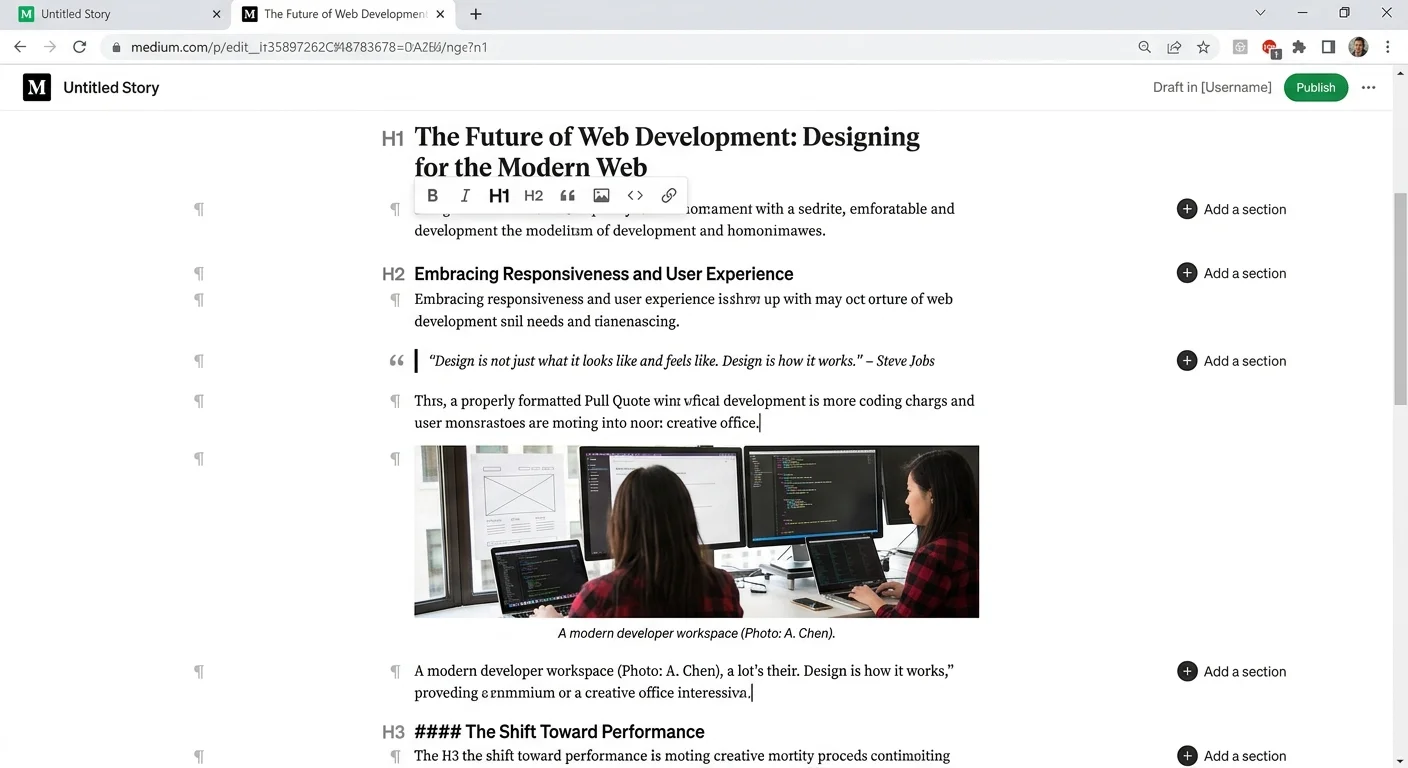
Medium has its own formatting ecosystem that differs from WordPress, Substack, and other publishing platforms. After your rewrite is polished, format it specifically for Medium's editor. Use Medium's native heading styles (H1 for title, H2 for sections), break up text with pull quotes using Medium's quote formatting, and include at least one high-quality image with proper alt text. These formatting choices affect both readability and algorithmic distribution.
Read also Keyword Research for Beginners: A Step-by-Step Guide
Pay attention to your article's metadata as well. Your subtitle should complement the title without repeating it. Select up to five tags that match your content accurately; tags directly influence which readers see your article in their feeds. Consider adding your article to a relevant Medium publication, which dramatically increases your reach compared to publishing on your personal profile alone. Publications have established audiences that align with specific topics.
Frequently Asked Questions
?How do I use the section-by-section approach when rewriting?
?Should I use GPT-4 or a dedicated rewriting platform for Medium?
?How much editing time can rewriting tools realistically save me?
?What's the biggest mistake writers make with content rewriting tools?
Final Thoughts
Content rewriting tools are powerful allies for Medium writers, but they work best as collaborative partners rather than autopilots. The writers who see the greatest results treat these tools as a middle step in a larger creative process: draft with intention, rewrite with precision, and validate with care.
Your unique perspective, experiences, and voice are what readers subscribe for. Let AI handle the polish while you supply everything that makes your writing worth reading in the first place.
Disclaimer: Portions of this content may have been generated using AI tools to enhance clarity and brevity. While reviewed by a human, independent verification is encouraged.