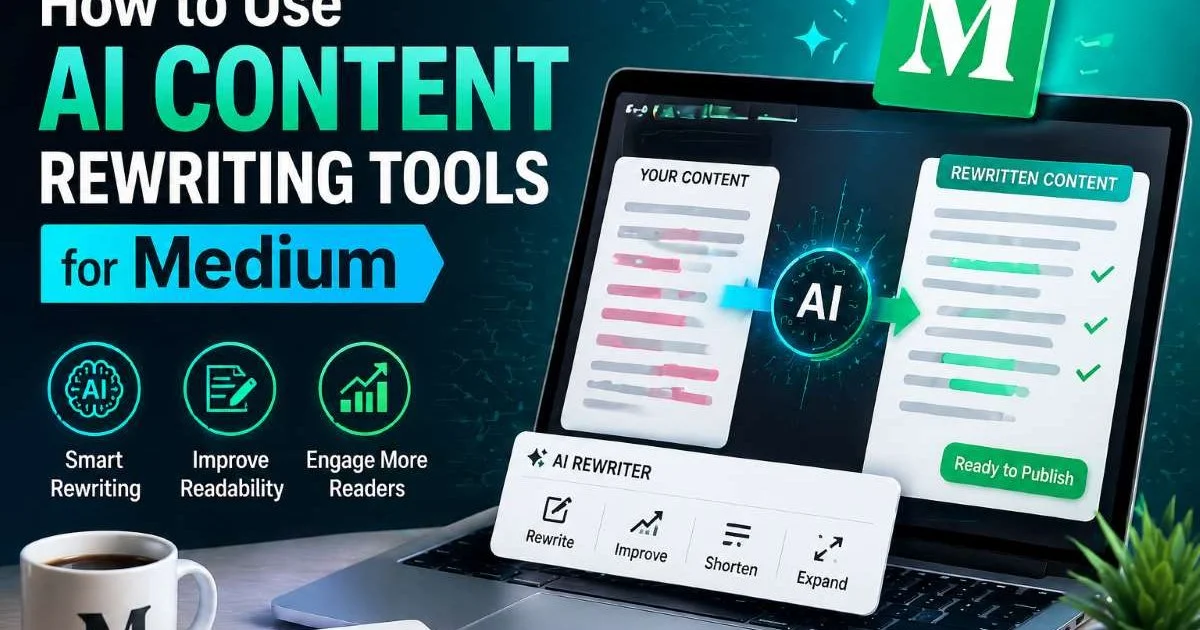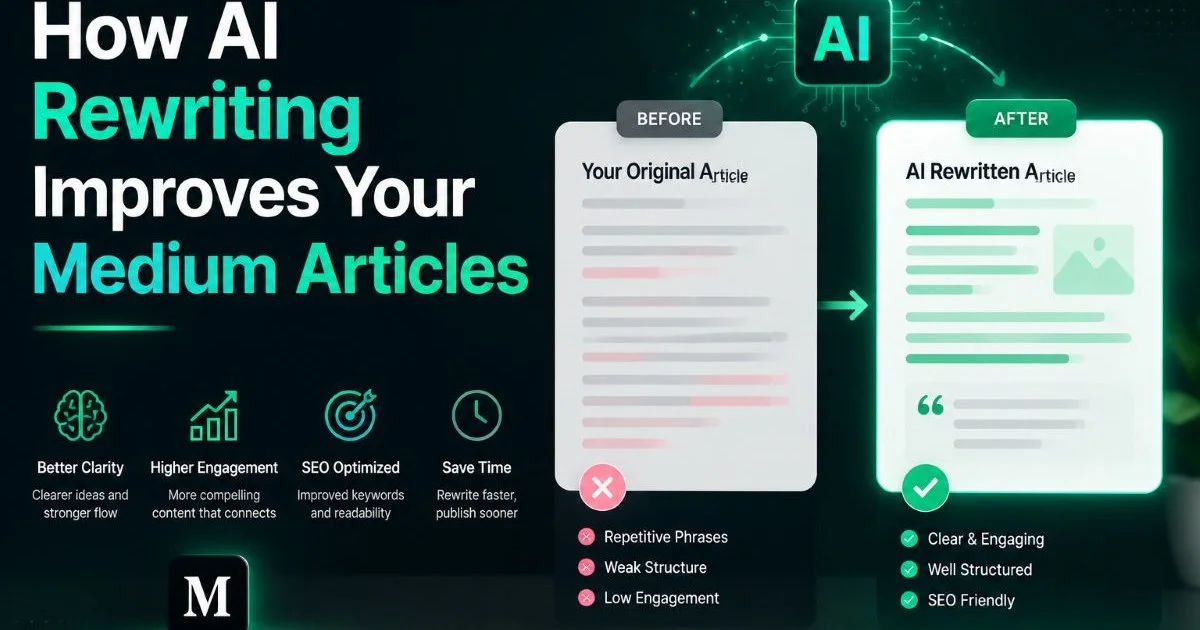
If you want to improve Medium articles, AI rewriting tools offer one of the most practical paths from rough draft to polished publication. Medium rewards clarity, strong structure, and reader engagement. Yet many aspiring writers struggle to transform their initial ideas into content that actually performs.
The gap between a first draft and a finished article is where most writers lose momentum, and that's exactly where AI rewriting steps in. By restructuring sentences, tightening prose, and aligning your content with SEO best practices, AI tools can accelerate your workflow without stripping away your voice.
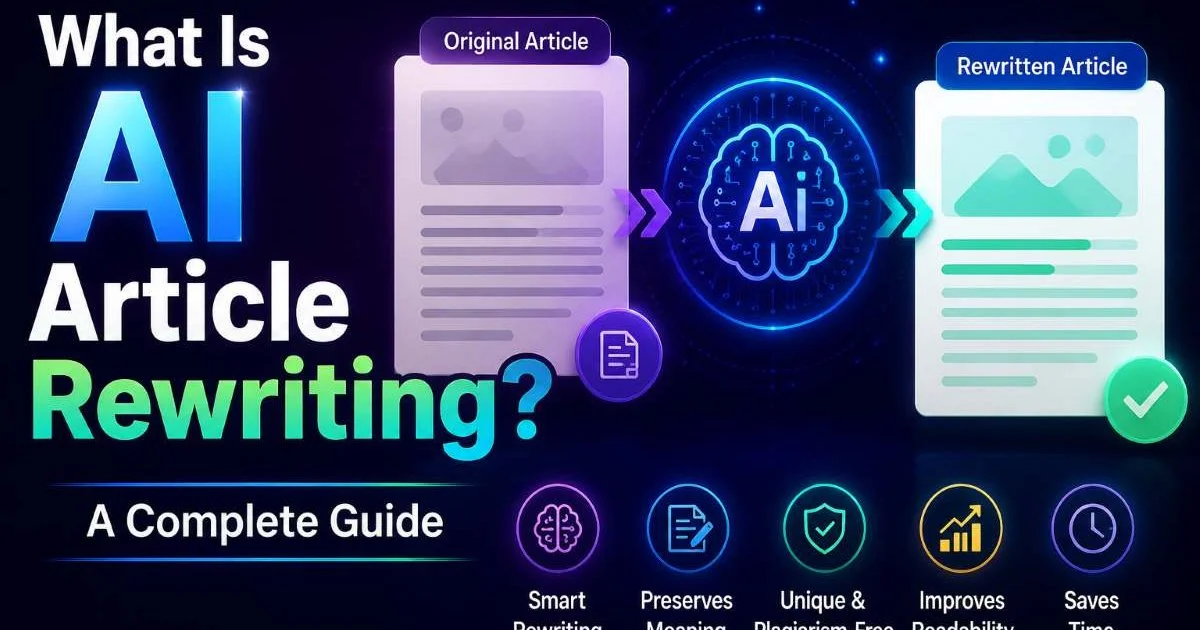
This guide walks you through four concrete steps to use AI rewriting effectively, so your Medium articles attract more readers and keep them scrolling. Understanding what AI article rewriting actually involves is a strong starting point before applying these techniques.
Key Takeaways
- AI rewriting tools help you improve Medium articles by fixing structure, flow, and readability fast.
- Always start with a complete rough draft before feeding content into any AI tool.
- Use AI to identify weak transitions, passive voice, and unnecessarily complex sentences.
- Pair AI suggestions with your own editorial judgment to preserve authenticity and voice.
- Optimized articles consistently outperform unedited drafts in Medium's recommendation algorithm.
Step 1: Prepare Your Draft for AI Rewriting
Before any AI tool can help, you need raw material worth rewriting. Too many writers open a blank document inside an AI platform and expect it to generate original thought. That's not rewriting; that's generation, and the results rarely sound like you. Start by writing a rough draft in your own words, even if it's messy, incomplete, or riddled with notes to yourself. The goal is to capture your core argument and supporting points.
What Makes a Good Input Draft
A good input draft has a clear thesis, at least three to five supporting sections, and some form of conclusion. It doesn't need perfect grammar. It doesn't need polished transitions. What it does need is substance. If you've ever wondered how to turn a draft into a Medium article with AI, the answer starts here: give the tool something real to work with, not a skeleton of bullet points.
Think of your draft as a sculptor's block of marble. The AI rewriting tool is the chisel, not the stone. Writers who dump a 200-word outline into an AI tool and expect a 1,500-word article end up with generic filler that reads like every other AI-generated piece on the platform. Medium's audience is sharp. They'll notice. Spend 30 to 45 minutes writing freely before you bring any technology into the process.
Write your first draft in a distraction-free editor like iA Writer or Google Docs before moving to any AI tool.
Organize your draft into rough sections with working headers. Label each section with the point you're making. This structure gives the AI context about your argument's flow, which produces significantly better output. The difference between a well-structured input and a stream-of-consciousness dump is dramatic. You'll save time on revisions later if you invest ten minutes organizing now.
Step 2: Choose the Right AI Rewriting Tool
Not all AI writing tools serve the same purpose. Some are built for generating content from scratch, while others specialize in rewriting and refinement. For Medium writers, rewriting-focused tools are the better choice because they preserve your ideas while improving execution. A detailed breakdown of AI content rewriting tools for Medium writers can help you understand which platforms match your workflow and budget.
Comparing Popular Options
When evaluating tools, consider factors like tone control, output quality, and how well the platform handles long-form content. Some tools excel at paragraph-level rewriting but struggle with full articles. Others offer style personas that let you match Medium's conversational yet informative tone. Choosing the best LLM for writing tasks can make a real difference in output quality, especially for nuanced rewrites that need to sound human.
The best AI writing tools for rewriting blog posts typically offer granular control over output. Look for tools that let you adjust formality, sentence length, and vocabulary complexity. Medium readers expect a conversational but intelligent tone. A tool that only outputs corporate-sounding prose will hurt more than it helps. Test at least two or three platforms with the same paragraph to compare results before committing.
Price matters too, but don't default to free tools expecting professional results. Most free-tier AI rewriters impose word limits, lack tone controls, and recycle phrasing in predictable ways. A paid tool at $15 to $30 per month pays for itself if it saves you two to three hours of editing per article. That's time you can spend on research, promotion, or writing your next piece.
Free AI rewriting tools often insert filler phrases and generic transitions that can trigger Medium's quality filters.
Step 3: Rewrite and Refine Section by Section
Here's where the real work happens. Feed your draft into the AI tool one section at a time, not all at once. Processing an entire 1,500-word article in a single pass often produces inconsistent tone shifts and loses the thread of your argument between sections. Working section by section gives you tighter control and lets you catch problems before they compound. This approach will genuinely improve Medium articles because it treats each part of your essay as its own unit.
Editing With Intention
After receiving the AI's output for each section, read it aloud. This sounds old-fashioned, but it's the fastest way to catch awkward phrasing that looks fine on screen but sounds robotic when spoken. Mark sentences where the AI changed your meaning, not just your wording. Meaning shifts are the most common problem with AI rewriting, and they're the hardest to spot if you're skimming. Pay special attention to any claims or statistics the tool may have subtly altered.
| Issue | Example | Fix |
|---|---|---|
| Meaning drift | "Most writers struggle" becomes "All writers fail" | Revert to original qualifier |
| Over-formalization | "It is imperative to note" replacing "Keep in mind" | Use conversational phrasing |
| Passive voice insertion | "The article was written by the author" | Switch to active: "The author wrote" |
| Filler phrases | "In today's fast-paced digital world" | Delete entirely |
| Lost transitions | Abrupt topic shift between paragraphs | Add a bridging sentence manually |
Compare the AI output against your original draft paragraph by paragraph. Keep a running document with both versions side by side. Accept changes that genuinely improve clarity or flow, and reject changes that flatten your personality. Your voice is what makes readers follow you on Medium, not perfect grammar. The best rewritten articles blend AI precision with human warmth, and that blend requires active editorial decisions from you at every step.
"The best rewritten articles blend AI precision with human warmth, and that blend requires active editorial decisions from you."
Don't be afraid to run a section through the AI tool twice with different instructions. First pass: "Tighten this paragraph and remove redundancy." Second pass: "Make the tone more conversational while keeping the facts." Layered passes produce noticeably better results than a single all-purpose rewrite request. Each pass addresses a different quality dimension, much like how a professional editor might do a structural pass followed by a line edit.
Use specific rewriting prompts like "simplify this for a general audience" rather than vague instructions like "make this better."
Step 4: Optimize for Medium's Algorithm and Readers
Rewriting for quality is only half the equation. If you want to improve Medium articles in terms of reach, you also need to think about how Medium's recommendation system evaluates content. Medium prioritizes read ratio (how much of the article people actually read), claps, and response engagement. AI rewriting can directly affect your read ratio by making your prose more scannable, your paragraphs shorter, and your hooks stronger at the section level.
SEO and Engagement Signals
Medium articles also surface in Google search results, which means basic SEO practices still apply. Use your focus keyword naturally in your title, subtitle, first paragraph, and at least two subheadings. Understanding how AI content generators improve SEO for blog content can inform your optimization strategy. But don't stuff keywords. Medium's audience will bounce if your article reads like it was written for a search engine rather than a human being.
Format your article for maximum readability before publishing. Use subheadings every 200 to 300 words. Bold key phrases sparingly. Include at least one list or table to break up continuous prose. These formatting choices directly impact how long readers stay on your article, which feeds back into Medium's algorithm. AI tools can suggest formatting improvements, but you'll want to make final layout decisions yourself based on how the article looks in Medium's editor.
Finally, write a strong subtitle and opening image caption. These elements appear in Medium's feed and email digests, making them your first impression. AI rewriting is particularly useful here because you can generate five to ten subtitle variations in seconds and pick the most compelling one. A/B testing isn't possible on Medium, but generating multiple options and choosing the strongest is the next best thing. This final optimization step can meaningfully improve Medium articles' click-through rates from the homepage.
Don't publish AI-rewritten content without a final manual review. Medium may reduce distribution of articles flagged as low-quality or AI-generated.

Frequently Asked Questions
?How long should my rough draft be before using an AI rewriting tool?
?Is AI rewriting on Medium better than just using AI to generate the article?
?How much time does AI rewriting actually save when polishing a Medium article?
?Will using AI rewriting tools strip away my personal voice on Medium?
Final Thoughts
AI rewriting tools are practical allies for aspiring Medium writers who want to improve Medium articles without spending hours on manual editing. The key is treating AI as an assistant, not an author. Start with a real draft, choose the right tool, rewrite section by section, and optimize for both readers and the algorithm. Writers who follow this process consistently will see stronger engagement, higher read ratios, and a growing audience on Medium. The technology handles the tedious parts; your job is to bring the insight.
Disclaimer: Portions of this content may have been generated using AI tools to enhance clarity and brevity. While reviewed by a human, independent verification is encouraged.